NoA Ignite Designing human-centered digital services in consultancy agency
Summary
Holistic experience design at scale
Through holistic experience design, co-creation, lean and agile methodology, prototyping, and continuous user testing, I help organizations create digital services that are user friendly without compromising business goals. My work consistently delivers accessible products that meet WCAG 2.1 AA standards while achieving exceptional user satisfaction, enabling customers to manage their needs independently and efficiently, regardless of their abilities or technical expertise.
Due to strict NDAs, I have only presented my design thinking and processes on this page. If you want to talk more about my current or previous projects, you can contact me via email.
Challenge
Self-service, accessibility, and business alignment
Digital services often face a fundamental challenge: users want to handle matters independently online, yet expect seamless experiences regardless of how they choose to interact. The challenge lies in creating solutions that maximize self-service automation while maintaining accessibility compliance and providing seamless experiences across all touchpoints. Equally important is balancing user needs with business objectives — every design decision must serve both the user and the client, requiring thoughtful and transparent communication with strategic planning that does not sacrifice either perspective.
Common challenges to tackle
- Fragmented user journeys: Disconnected experiences across different touchpoints that create confusion and friction.
- Dense information architectures: Overwhelming users with too much information rather than presenting what they actually need.
- Accessibility barriers: Excluding users with diverse needs through designs that do not consider different abilities and technical expertise.
- Competing priorities: Aligning stakeholder requirements, business constraints, and user expectations while finding solutions that satisfy all parties without compromising core values.
The goal is clear: design digital services where clarity, efficiency, and transparency lead users to accomplish their goals confidently while delivering measurable business value and maintaining strategic alignment with client objectives.
Approach
Double diamond thinking, accessibility by default
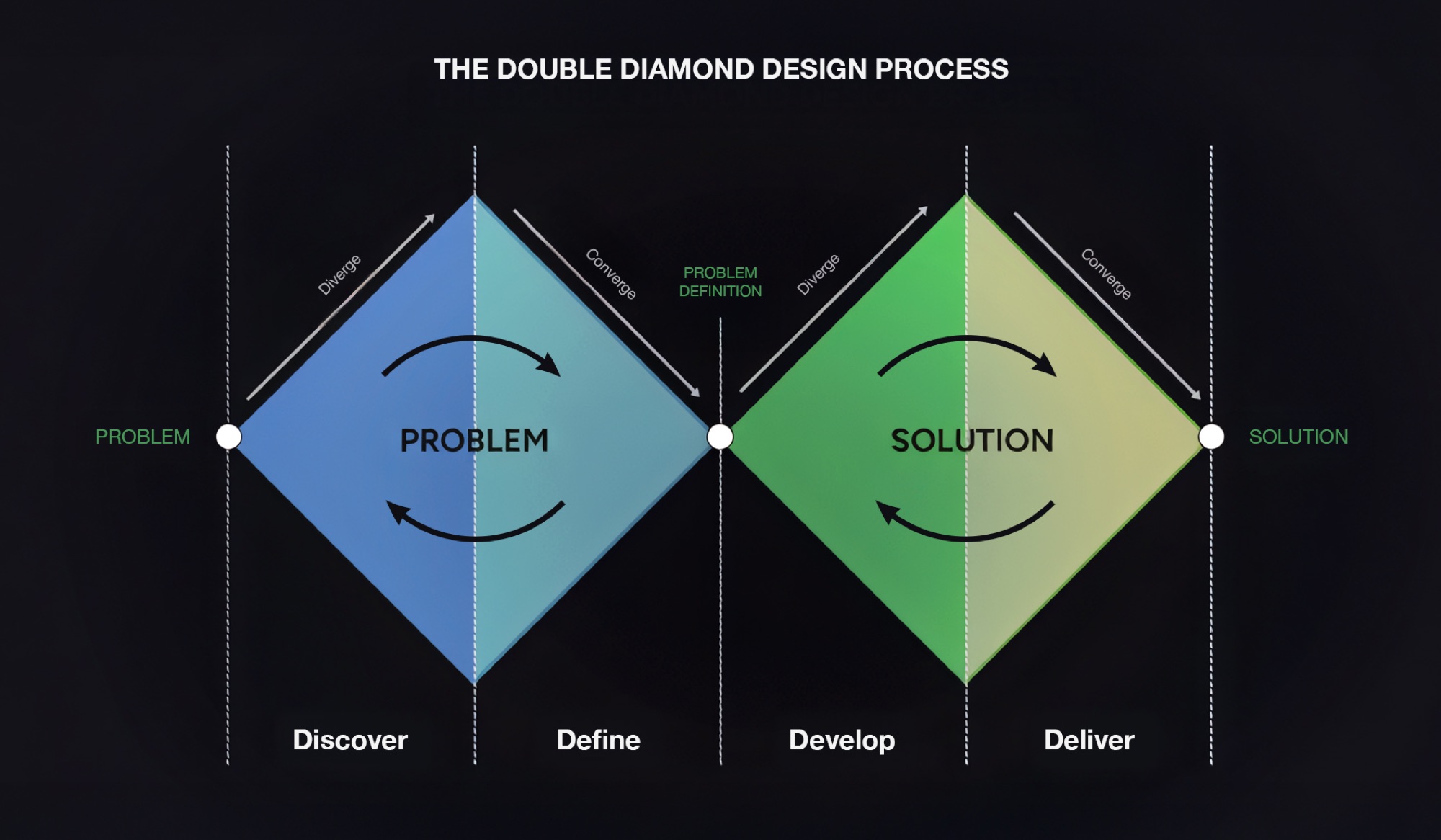
I use a holistic design thinking process with different variations of the double diamond methodology to ensure thorough problem exploration and solution validation. Some variations are more strict and some are more loose if the challenge at hand requires it. Accessibility is never treated as an afterthought — it is built into every design phase, from initial concepts through prototypes and finally to live products. This integration not only ensures WCAG 2.1 AA compliance but improves efficiency and reduces production costs.
My typical process includes
- Co-creation workshops: Running workshops with multidisciplinary teams. Collaborating closely with stakeholders to align on solutions that balance design best practices and business goals, ensuring all voices are heard in the process.
- Rapid prototyping: Creating high-fidelity functional prototypes (e.g. Figma or HTML with developers) that allow stakeholders to experience interactions on their own and validate business requirements. If HTML prototypes are developed in this phase, technical accessibility needs are met for screen readers.
- User-centric research and testing: Planning and conducting user testing sessions, analyzing findings, and presenting results with justified design decisions that benefit both user and business needs.
- Developer collaboration and implementation: With strong knowledge of front-end development (HTML, CSS), communicating design specifications and implementation details effectively to development teams, bridging the gap between design vision and technical execution through clear documentation and collaborative problem-solving. For reference, I designed and developed this portfolio from scratch without any frameworks.
- Iterative, lean, and agile methodology: Working in rapid cycles across all aspects of the design process, favoring continuous testing and learning over lengthy planning phases. Adapting quickly to feedback and changing requirements while maintaining focus on delivering value.
- AI-assisted workflows: Leveraging tools like Claude, Google AI Studio, ChatGPT, and similar LLMs throughout the design process for mindful ideation, coding support, research synthesis, and content creation to accelerate iteration cycles and explore diverse solutions.
Every interaction is crafted with cognitive empathy, considering diverse user needs and capabilities. From optimizing form fields for screen readers to designing clear user flows that minimize friction, attention to detail drives meaningful impact. I focus on creating user-centric interfaces that present essential information concisely without overwhelming users with unnecessary data, fostering trust through transparent and detailed communication. Through strong verbal and presentation skills, I guide stakeholders through design rationale, building shared understanding and confidence in user-centered decisions.
Outcome
Validated impact and tangible value
Results consistently validate the user-centered approach. Post-launch Net Easy Score (NES) measurements typically exceed expectations, with completed projects achieving scores of 78–86 — significantly above the 65 threshold considered “very good.” These scores reflect not just initial reactions but sustained satisfaction as users continue engaging with the services. Automation functions as designed, reducing friction while maintaining accessibility standards and preserving different pathways for different users.
Beyond metrics, my work delivers tangible value
- Pleasant aesthetics: Designing modern, minimalistic UIs that are intuitive for users.
- Clutter-free interfaces: Presenting only necessary information without overwhelming users with unnecessary data.
- Seamless user experiences: Always considering the whole user journey, not just single user flows.
- Scalable design patterns: Creating reusable components and patterns that ensure consistency across products and enable faster development cycles.
- Effortless compliance: Integrating accessibility into the design process, making WCAG standards a natural outcome rather than a burden.
- Stakeholder confidence: Leading by example and supporting collaborative environments where team members can thrive.
Overall clients have been highly satisfied with my work and value the collaboration, appreciating the transparent communication, clear processes, and ease of working together throughout various projects.
Read about current project